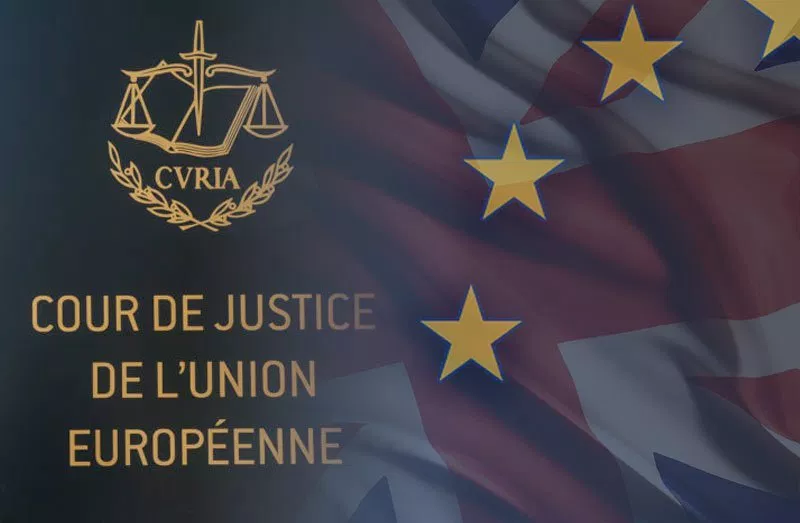
Can the European Court Disrupt the Brexit Negotiations?
In this September 2018 post, Diane James MEP describes a committee session in Brussels and the legal idea that emerged from it. The commentary is written from her perspective and reflects her opinions.
The political backdrop
She opens by noting the many obstacles to a Brexit deal as she saw them. Labour was threatening to reject any agreement that went beyond a nominal departure, and the Scottish National Party, in her view, wanted to stretch out the talks so as to postpone a decision on a second independence vote. Meanwhile, she says, even the EU’s own legal setting, based on the Article 50 withdrawal clause, was now being questioned.
The professor’s argument
The Parliament’s Constitutional Affairs Committee heard from Christophe Hillion, a specialist in EU institutional law. He had earlier suggested that Scotland aim for membership of the European Economic Area. His priority, she explains, is protecting the integrity of the single market, including free movement.
Hillion told the committee that the withdrawal process must pass three tests. It has to respect EU primary law, it has to respect the accumulated body of EU rules known as the acquis, and it has to serve the Union’s broader goals. She reads this as saying that a member cannot leave if leaving is inconvenient for the rest.
He also argued that:
- the dispute settlement mechanism meant to let Theresa May say the European Court of Justice would not be the final authority was itself at odds with EU law, because it would weaken the Court’s powers, and the Court had rejected a similar proposal before in connection with expanding the European Economic Area;
- a failure to settle how Brexit applies to the EEA and the EFTA states, such as Norway and Liechtenstein, already amounts to fragmentation of the single market; and
- by using the withdrawal stage to move ahead on future relations, the Council had exceeded its mandate.
What could happen
In practice, he said, Parliament could ask the Court of Justice to rule before the talks finished, or at least before 29 March. Past strict readings of core EU law, he suggested, make a ruling that derails the process quite plausible. She notes that one well-known German MEP seemed eager to talk to him afterwards.
The Council’s response
She says her team raised the idea with the Council’s chief legal adviser, Hubert Legal, ahead of an October summit and a planned November one. He conceded that the legal reasoning had merit, but felt that Parliament as a whole would never use such a drastic option. He suggested the only realistic route was a challenge brought by citizens, which she links to the idea of a second public vote, with time running short.
Why it matters
Whether or not such a case ever reached the Court, the episode shows how the legal and political tracks of Brexit overlapped. Procedure, the role of the Court of Justice and the position of the EEA countries were all part of the argument, and the author uses the anecdote to suggest that those favouring a different outcome might turn to litigation. Readers who want a neutral view of the law should read the professor’s own published work instead of this summary.
She closes with a rhetorical “Next?” and leaves the question open.